


Zoho Data Centers in the Middle East: Where Is Your Business Data Hosted in 2026? UAE, Saudi Arabia & Data Sovereignty Explained.

In 2026, data location is no longer a technical consideration hidden inside an IT policy document. It has become a boardroom discussion. From government entities in the UAE to enterprises in Saudi Arabia, India, and across the Middle East, organizations are increasingly asking a simple but critical question:
Where exactly is our business data stored?
The answer matters because regulations, cybersecurity mandates, customer trust, and operational resilience are now closely tied to data residency and sovereignty requirements. As cloud adoption accelerates across the Gulf region, businesses must ensure that their software vendors can support local hosting requirements without compromising performance or security.
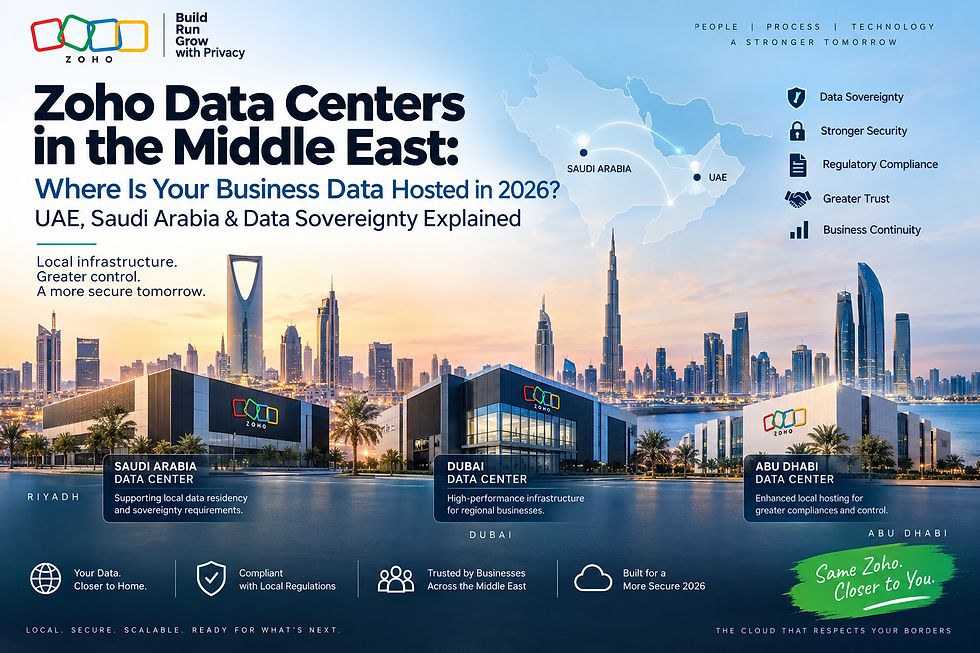
For organizations using Zoho or considering migration to the Zoho ecosystem, the good news is that Zoho has significantly expanded its Middle East infrastructure footprint. With operational data centers in both Saudi Arabia and the UAE, businesses now have more control over where their information is stored than ever before. Zoho officially expanded its Middle East infrastructure with Saudi Arabia data centers and later launched new data centers in Dubai and Abu Dhabi to support local data residency and sovereignty requirements. [zoho.com], [zoho.com], [enterpriseam.com]
As a leading Zoho Implementation, Consulting, Training, and Support Partner, Magistrum Corpserve helps organizations across India, UAE, Saudi Arabia, Africa, and global markets select the right Zoho deployment strategy while ensuring compliance, business continuity, and long-term scalability.
Why Data Location Matters More Than Ever
Cloud software transformed business operations over the last decade. However, as businesses moved customer data, financial records, employee information, and operational workflows into the cloud, governments worldwide introduced stricter regulations governing how that data should be handled.
Today's organizations are concerned about:
Data sovereignty
Regulatory compliance
Data privacy
Cybersecurity requirements
Cross-border data transfers
Industry-specific regulations
Disaster recovery readiness
For many businesses, particularly in finance, healthcare, education, government contracting, and technology sectors, data location can determine whether a cloud platform is compliant with local laws.
This is especially relevant throughout the Middle East, where governments are investing heavily in digital transformation while simultaneously strengthening national cybersecurity and data governance frameworks.
Understanding Data Residency vs Data Sovereignty
Before discussing Zoho's Middle East infrastructure, it's important to understand two terms that are often confused.
What Is Data Residency?
Data residency refers to the physical location where data is stored.
For example:
Data stored in Dubai is resident in the UAE.
Data stored in Riyadh is resident in Saudi Arabia.
Data stored in Mumbai is resident in India.
Simply put, residency answers the question:
"Where is the data physically located?"
What Is Data Sovereignty?
Data sovereignty goes a step further.
It refers to the laws and regulations that apply to data because of the country in which it resides.
When customer information is stored within a particular nation, it may become subject to that country's legal and regulatory framework.
This is why many governments now prefer cloud providers that offer in-country hosting.
Why Enterprises Care About Both
A business may technically have its data stored nearby, but if compliance requirements demand local sovereignty protections, residency alone might not be enough.
Decision-makers must evaluate:
Storage location
Processing location
Backup location
Disaster recovery location
Regulatory obligations
Vendor compliance certifications
Zoho's recent regional expansion addresses many of these concerns directly.
Zoho's Global Data Center Strategy
Unlike many SaaS providers that route customer data through a limited number of global regions, Zoho has continuously expanded its international infrastructure footprint.
According to Zoho's published data center information, customers can select regional hosting options that align with their geography and compliance requirements. Zoho currently supports data center regions including the United States, Europe, India, Australia, Japan, Canada, Saudi Arabia, UAE, Singapore, and others depending on service availability. [zoho.com]
Major Zoho Data Center Regions
United States
Serving North and South American customers.
European Union
Supporting GDPR-sensitive organizations across Europe.
India
Supporting India's growing startup, SMB, and enterprise ecosystem.
Canada
Serving organizations with Canadian data residency requirements.
Australia
Supporting businesses across Oceania.
Japan
Providing localized hosting for Japanese organizations.
Saudi Arabia
Supporting organizations requiring Saudi-hosted data.
United Arab Emirates
Supporting UAE-based enterprises, government entities, and regulated industries.
Zoho's regional approach allows businesses to align cloud infrastructure with local compliance expectations while maintaining platform consistency across geographies. [zoho.com], [help.zoho.com]
Zoho's Saudi Arabia Data Centers: A Major Milestone for the Gulf
Saudi Arabia has emerged as one of the most important digital economies in the Middle East.
Driven by Vision 2030 initiatives, public sector digitization, fintech growth, smart city investments, and increasing cloud adoption, demand for locally hosted data continues to rise.
Zoho responded to this demand by establishing data center infrastructure in Saudi Arabia. Industry reports confirm that Zoho's Saudi cloud regions include facilities in Riyadh and Jeddah. [manageengine.com], [blog.nexivo.co]
Why Saudi Hosting Matters
For Saudi organizations, locally hosted data can help support:
Data localization strategies
Public sector procurement requirements
Cybersecurity initiatives
Industry compliance frameworks
Customer trust
Businesses operating in Saudi Arabia increasingly prefer cloud vendors capable of offering in-country data storage rather than relying on overseas hosting environments.
Industries Benefiting from Saudi Data Hosting
Banking and Financial Services
Financial institutions face rigorous compliance obligations and cybersecurity expectations.
Healthcare
Patient confidentiality requirements are driving greater demand for localized data infrastructure.
Government
Government entities often prioritize nationally hosted cloud solutions.
Enterprise Businesses
Large organizations increasingly require greater visibility into where business-critical information resides.
Zoho Launches UAE Data Centers in Dubai and Abu Dhabi
One of the most significant developments in 2026 was Zoho's launch of new UAE-based data centers in Dubai and Abu Dhabi. The initiative forms part of Zoho's broader regional investment strategy and was specifically designed to strengthen local hosting capabilities for Middle East customers. [zoho.com], [datacenter...namics.com], [dubaidailynews.net]
According to Zoho, these facilities host both Zoho and ManageEngine cloud solutions while supporting local data residency requirements. [zoho.com], [dubaidailynews.net]
Why UAE-Based Hosting Is Important
The UAE is one of the fastest-growing cloud markets globally.
Organizations across Dubai, Abu Dhabi, Sharjah, and other Emirates increasingly require:
Faster cloud performance
Lower latency
Stronger local compliance alignment
Improved disaster recovery options
National data residency support
By introducing UAE-hosted infrastructure, Zoho enables customer data to remain within the country while supporting local cybersecurity and governance objectives. [zoho.com], [enterprise...imes.co.uk]
The Business Case for UAE Data Residency
UAE enterprises are becoming increasingly selective when evaluating cloud vendors.
The conversation has moved beyond features and pricing.
Today, procurement teams also ask:
Where is the data stored?
Which certifications apply?
Can government requirements be met?
How is data protected?
Can local hosting be guaranteed?
Zoho's UAE expansion directly addresses these concerns by providing in-country hosting capabilities through facilities located in Dubai and Abu Dhabi. [zoho.com], [datacenter...namics.com]
Benefits of UAE Data Hosting
Reduced Latency
Applications hosted closer to users often deliver faster response times.
Local Compliance Alignment
Organizations can better align internal governance policies with local hosting requirements.
Enhanced Customer Confidence
Customers increasingly prefer providers that prioritize regional infrastructure.
Improved Operational Resilience
Regional infrastructure supports business continuity and disaster recovery strategies.
Zoho's Approach to Data Sovereignty
Zoho has consistently positioned privacy as a core business principle.
Its infrastructure strategy reflects a commitment to helping organizations maintain greater control over their information.
According to Zoho, the expansion of UAE data centers strengthens data sovereignty by allowing organizations to retain data within national borders. [zoho.com], [enterprise...imes.co.uk]
This becomes especially important for:
Government organizations
Semi-government entities
Regulated industries
Enterprise customers
Multinational companies with local subsidiaries
Local Data Storage
For many organizations, local storage requirements are no longer optional.
Holding data within the UAE or Saudi Arabia can simplify compliance programs and reduce uncertainty regarding cross-border transfers.
Regional Trust
A provider's willingness to invest in local infrastructure demonstrates long-term commitment to a market.
This can become a significant factor during vendor selection.
Compliance and Security Standards
Security remains one of the biggest concerns in cloud adoption.
Zoho's UAE infrastructure has received certifications and compliance recognitions that help support highly regulated customer environments.
Reported certifications include:
CSP Security Standard certification from the Dubai Electronic Security Center (DESC)
ISO 27001
ISO 22301
ISO 27017
CSA STAR Level 2 certification
These certifications help establish security, continuity, operational management, and cloud governance standards for hosted environments. [zoho.com], [dubaidailynews.net], [dubaiprnetwork.com]
What This Means for Indian Businesses Expanding to the UAE and Saudi Arabia
India and the Gulf maintain deep economic relationships.
Thousands of Indian businesses operate across:
UAE
Saudi Arabia
Qatar
Oman
Bahrain
Kuwait
Many Indian companies use Zoho applications for:
CRM
Finance
HR
Customer support
Project management
Marketing automation
As these organizations expand into Middle Eastern markets, data location becomes increasingly important.
Common Questions We Hear
Should Indian companies host data in India or UAE?
The answer depends on:
Customer location
Regulatory requirements
Business structure
Industry obligations
Regional operations
Can GCC subsidiaries use UAE-hosted Zoho environments?
In many cases, businesses choose regional hosting strategies based on operational and compliance needs.
What about multinational organizations?
Global enterprises often evaluate data center selection alongside governance, security, and integration requirements.
This is where experienced implementation guidance becomes invaluable.
Choosing the Right Zoho Data Center
Selecting a data center should never be treated as an afterthought.
It impacts:
Compliance
User experience
API configurations
Integrations
Long-term governance
Factors to Consider
Business Location
Where are your primary operations conducted?
Customer Geography
Where does most customer information originate?
Regulatory Requirements
Do customers require locally hosted data?
Future Expansion
Will your organization expand into new markets?
Integration Requirements
Will other business applications connect to Zoho?
How Magistrum Corpserve Helps Organizations Make the Right Decision
At Magistrum Corpserve, we work with organizations across India, UAE, Saudi Arabia, and other global markets to design scalable Zoho ecosystems aligned with business objectives and regulatory expectations.
As an experienced Zoho Implementation & Training Partner, our role extends far beyond software deployment.
We help businesses answer strategic questions such as:
Which Zoho data center should we select?
How will regional hosting affect operations?
What compliance considerations should be reviewed?
How should multi-country deployments be structured?
What migration approach minimizes disruption?
Zoho Consulting
We evaluate:
Business processes
Operational requirements
Compliance expectations
Regional growth plans
Zoho Implementation
Our team configures and deploys:
Zoho One
Zoho CRM
Zoho Books
Zoho People
Zoho Projects
Zoho Desk
Zoho Creator
Zoho Analytics
Zoho Workplace
Zoho Migration Services
For organizations moving from:
Salesforce
HubSpot
Microsoft platforms
Legacy ERP systems
Custom-built applications
we help ensure a smooth transition while addressing hosting and compliance considerations.
Zoho Training and Adoption
Technology delivers value only when teams use it effectively.
We provide:
User training
Administrator training
Process documentation
Governance frameworks
Ongoing support
This ensures long-term ROI from the Zoho ecosystem.
The Future of Data Sovereignty in the Middle East
The Middle East is rapidly becoming one of the world's most important cloud computing regions.
Several trends are shaping the future:
Government-Led Digital Transformation
Governments across the Gulf continue to invest heavily in cloud-first initiatives.
Growth of Regulated Industries
Banking, healthcare, education, and public services are becoming more digitally connected.
Increased Data Localization Requirements
Organizations increasingly prefer providers that support local hosting options.
AI and Data Governance
As artificial intelligence adoption accelerates, businesses are paying closer attention to where the underlying data resides.
These trends make regional cloud infrastructure more important than ever.
Final Thoughts
The question is no longer whether businesses should move to the cloud.
The question is:
Which cloud provider can deliver the right balance of functionality, security, performance, and data sovereignty?
Zoho's continued investment in regional infrastructure, including established data centers in Saudi Arabia and the launch of new facilities in Dubai and Abu Dhabi, gives organizations across the Middle East greater flexibility in meeting data residency and sovereignty requirements. [zoho.com], [enterprise...imes.co.uk], [manageengine.com]
For businesses in India, UAE, Saudi Arabia, and global markets, understanding where your data is hosted has become a strategic business decision, not merely an IT choice.
As a trusted Zoho Implementation, Consulting, Migration, and Training Partner, Magistrum Corpserve helps organizations navigate these decisions with confidence, ensuring that technology investments align with operational goals, regulatory expectations, and future growth plans.
Whether you're implementing Zoho for the first time, expanding into the Gulf region, or reviewing your cloud governance strategy, choosing the right data hosting framework today will help create a stronger, more compliant business tomorrow.
About Magistrum Corpserve
Magistrum Corpserve is a trusted Zoho consulting, implementation, customization, migration, integration, and training partner serving clients across India, UAE, Saudi Arabia, the Middle East, Africa, and global markets. We help businesses unlock the full potential of the Zoho ecosystem through strategic consulting, process automation, user adoption programs, and long-term digital transformation initiatives. For more information, visit https://www.magistrum.in.


Comments