


The Real Story Behind Microsoft's Changing Workspace Pricing Strategy — And Why More Businesses Are Looking at Zoho Workplace.

The Productivity Software Market Has Entered a New Era
For almost two decades, Microsoft has been the default choice for business productivity. Whether it was Outlook for email, Word for documentation, Excel for financial analysis, or Teams for collaboration, Microsoft 365 became deeply embedded into organisations of every size—from small family-run businesses in Kerala to multinational enterprises headquartered in Dubai, London, Singapore, and New York.
For many companies, choosing Microsoft was never really a decision. It was simply the standard.
However, the workplace has changed dramatically over the past five years. Hybrid work, cloud collaboration, cybersecurity threats, artificial intelligence, subscription-based software, and increasing pressure to reduce operational costs have forced business leaders to rethink technology investments. What was once viewed as a straightforward software purchase has evolved into a long-term strategic commitment.
Today, organisations are asking a different question:
"Are we paying for the tools we genuinely use, or are we paying for an ecosystem we've simply become accustomed to?"
That question is becoming increasingly important as software vendors refine their pricing strategies, introduce AI-powered features, and reshape licensing models. Microsoft is no exception.
Rather than viewing Microsoft's recent pricing decisions as isolated changes, it is more accurate to see them as part of a broader transformation taking place across the entire software industry.
At the same time, alternative platforms such as Zoho Workplace are attracting growing attention—not because businesses are abandoning Microsoft overnight, but because they are reassessing value, flexibility, and long-term return on investment.
For organisations across India, the UAE, the GCC, and global markets, this shift is creating an opportunity to evaluate productivity software with fresh eyes.
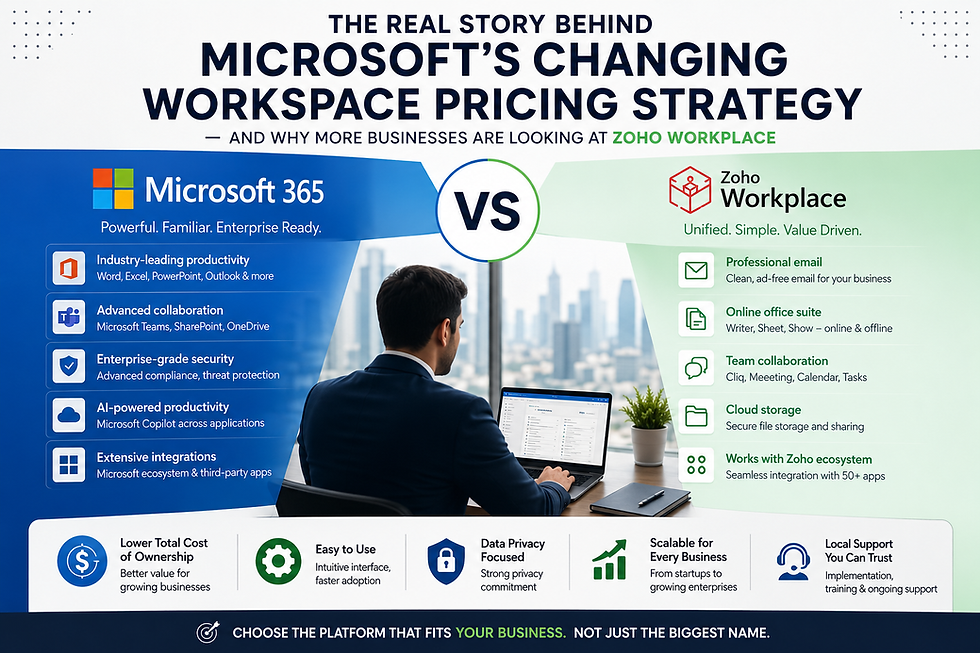
Why Microsoft's Pricing Strategy Is Changing
Software Companies No Longer Sell Products—They Sell Continuous Services
Years ago, purchasing Microsoft Office was simple. A company bought licences, installed the software, and used it for several years before considering an upgrade.
That model no longer exists.
Today, Microsoft delivers its workplace ecosystem as a continuously evolving cloud service. Instead of selling a one-time licence, Microsoft provides ongoing access to software, cloud storage, security updates, collaboration tools, AI capabilities, and compliance features through recurring subscriptions.
This approach benefits customers in many ways:
Continuous feature updates
Enhanced security
Cloud accessibility
Cross-device synchronisation
Integrated collaboration
Regular innovation
However, it also changes the economics of software.
Rather than focusing solely on the initial purchase price, businesses now commit to recurring operational expenditure. As organisations grow, add employees, adopt new features, or require advanced security, subscription costs naturally evolve.
Microsoft's pricing strategy reflects this broader shift toward delivering an expanding portfolio of services rather than a static software package.
Artificial Intelligence Has Changed the Economics of Productivity Software
AI Is Expensive to Build—and Even More Expensive to Operate
Artificial intelligence has become one of the largest technology investments ever undertaken by enterprise software companies.
Generative AI requires:
Massive cloud infrastructure
Running large language models demands enormous computing capacity distributed across global data centres.
Continuous model improvement
Unlike traditional software, AI systems require ongoing training, optimisation, and monitoring.
Enterprise-grade security
Business customers expect AI tools to meet strict privacy, compliance, and governance requirements.
Global scalability
Millions of users expect AI assistants to respond instantly, regardless of location.
These investments significantly increase operational costs.
Microsoft has invested heavily in AI integration across Microsoft 365, introducing intelligent capabilities into Word, Excel, Outlook, Teams, and other applications.
From Microsoft's perspective, pricing adjustments are part of funding continuous innovation while maintaining enterprise-grade reliability.
From a customer's perspective, however, the question becomes more nuanced:
"Do we actually need every AI capability included in our subscription?"
For some organisations, the answer is undoubtedly yes.
For many small and medium-sized businesses, however, the answer may be less straightforward.
Businesses Are Becoming More Cost-Conscious Than Ever
Every Software Subscription Is Now Under Review
Ten years ago, software budgets were relatively predictable.
Today, organisations subscribe to dozens of cloud platforms:
Accounting software
CRM systems
Payroll platforms
HR software
Project management tools
Communication platforms
Digital signature solutions
Cybersecurity services
Marketing automation
Analytics platforms
AI assistants
Individually, each subscription may appear affordable.
Collectively, they represent a significant operational expense.
Chief Financial Officers and business owners are increasingly evaluating software not only by features but also by measurable business outcomes.
Questions now include:
Are employees actively using premium features?
Which licences remain unused?
Are multiple platforms performing similar tasks?
Can operational complexity be reduced?
Is there a better return on investment elsewhere?
This renewed financial discipline is encouraging organisations to reassess long-standing software decisions.
The Rise of Value-Driven Decision Making
Businesses Want More Than Brand Recognition
For years, purchasing decisions often favoured globally recognised technology brands.
While reputation remains important, modern buyers are becoming increasingly analytical.
Decision-makers now compare:
Total cost of ownership
Ease of implementation
Integration capabilities
User adoption
Customer support
Vendor flexibility
Future scalability
Data ownership
Security compliance
Brand recognition alone is no longer sufficient.
Instead, organisations seek technology that aligns with their operational requirements rather than simply following industry convention.
This shift explains why productivity software comparisons have become more sophisticated.
Businesses are no longer asking:
"Which platform is more popular?"
Instead, they ask:
"Which platform delivers the greatest business value for our organisation?"
Why Zoho Workplace Has Entered More Conversations
A Different Philosophy Toward Business Software
Zoho has taken a noticeably different approach to building business software.
Rather than focusing exclusively on large enterprise customers, Zoho has consistently developed solutions for organisations ranging from startups to mid-sized businesses and growing enterprises.
Its philosophy has emphasised:
Integrated applications
Predictable pricing
Strong privacy commitments
Limited reliance on advertising revenue
Native integration across business applications
Simplified administration
Instead of encouraging organisations to assemble multiple disconnected products from different vendors, Zoho has invested in building a unified ecosystem where email, documents, meetings, chat, file storage, project collaboration, CRM, accounting, HR, and business intelligence can work together.
For many organisations, this integrated approach reduces administrative overhead while simplifying day-to-day operations.
The conversation therefore becomes less about replacing Microsoft and more about evaluating whether an organisation's existing productivity environment still aligns with its evolving business needs.
The Changing Priorities of Businesses in India, the UAE, and the GCC
Digital transformation is accelerating across India and the Middle East.
Government initiatives, evolving compliance requirements, cloud adoption, and increased cybersecurity awareness are encouraging businesses to modernise their operations.
Small and medium-sized enterprises, in particular, are seeking technology platforms that offer:
Lower operational complexity
Managing multiple disconnected software systems consumes valuable administrative time.
Predictable operational costs
Stable subscription models make budgeting easier.
Better collaboration
Distributed teams require seamless communication regardless of location.
Easier onboarding
Employees should be productive quickly without extensive training.
Future-ready platforms
Businesses increasingly prefer software ecosystems capable of supporting future growth without requiring frequent platform changes.
These priorities have naturally expanded the conversation around platforms such as Zoho Workplace.
For organisations evaluating productivity suites today, the discussion is no longer centred solely on email or document editing. It encompasses operational efficiency, long-term value, integration, and strategic flexibility.
The Question Business Leaders Should Really Be Asking
The debate is not about whether Microsoft 365 is a good platform—it unquestionably remains one of the world's most capable productivity ecosystems.
The more important question is this:
Is your organisation paying for the platform that best matches how your teams actually work today?
For some businesses, Microsoft 365 will continue to be the ideal choice.
For others—particularly growing SMEs, service providers, trading companies, educational institutions, and businesses seeking an integrated business ecosystem—Zoho Workplace may offer a more practical and cost-effective path forward.
Making that decision requires looking beyond subscription prices and examining the broader picture: implementation, user adoption, integration, productivity, and long-term business value.
The Hidden Costs of Microsoft 365 That Many Businesses Overlook
Every business owner knows the price printed on a software subscription page. Far fewer understand the true cost of running that software over the next five or ten years.
This distinction is important because software investments are rarely limited to monthly licence fees. They include implementation, administration, employee training, support, storage, security, compliance, and the inevitable cost of change as businesses grow.
When organisations evaluate Microsoft 365 solely on its subscription price, they often miss the broader financial picture.
That doesn't mean Microsoft 365 is expensive for every business. For many organisations, it delivers excellent value. The key is understanding what you're actually paying for and whether those capabilities align with your business needs.
Understanding Total Cost of Ownership (TCO)
The Subscription Fee Is Only One Part of the Equation
Technology consultants often refer to Total Cost of Ownership (TCO)—the complete cost of owning and operating a technology platform throughout its lifecycle.
For a productivity suite, TCO typically includes:
Licensing Costs
Monthly or annual subscription fees for every employee.
Storage Requirements
As businesses generate more emails, documents, presentations, and multimedia files, storage needs naturally increase.
Administration
User management, permission settings, security policies, backups, compliance configurations, and ongoing maintenance all require time and expertise.
Employee Training
Even familiar software requires training whenever new features are introduced or workflows change.
Security
Modern businesses cannot overlook cybersecurity. Multi-factor authentication, data protection, email security, and compliance controls have become essential rather than optional.
Integration
Very few organisations use a productivity suite in isolation.
Email platforms need to connect with CRM systems, accounting software, HR platforms, project management tools, and document management solutions.
Each additional integration adds complexity.
Complexity Often Grows Faster Than the Business
Many SMEs begin with a handful of Microsoft 365 users.
Over time they add:
Microsoft Teams
SharePoint
OneDrive
Power Automate
Microsoft Forms
Planner
Defender
Exchange Online
Intune
Copilot
Third-party applications
Individually, these are powerful products.
Collectively, they can become difficult for smaller IT teams to manage efficiently.
A business with ten employees might initially find administration straightforward.
A business with one hundred employees operating across multiple locations faces a very different reality.
As organisations expand into new offices, onboard remote employees, or operate across India, the UAE, Saudi Arabia, Oman, or other GCC countries, administration naturally becomes more demanding.
The challenge isn't the quality of Microsoft's products. It's ensuring that businesses have the expertise and resources to manage them effectively.
Are Businesses Paying for Features They Never Use?
The Feature Utilisation Challenge
Modern productivity platforms are packed with capabilities.
The question is not whether those features exist.
The question is whether employees actually use them.
Many organisations discover that:
Teams primarily use Outlook and Excel.
SharePoint adoption remains low.
Collaboration still happens through WhatsApp or third-party messaging platforms.
Advanced automation features remain untouched.
AI tools are available but rarely used.
Employees continue storing documents locally instead of using cloud collaboration.
This isn't unique to Microsoft.
Every enterprise software platform faces the same challenge.
The more capabilities a platform offers, the greater the risk that businesses pay for functionality that delivers little measurable value.
That is why many technology consultants encourage organisations to review software usage annually rather than assuming existing licences remain appropriate indefinitely.
The Cost of Switching Is Often Higher Than the Cost of Staying
One reason businesses remain with existing software is familiarity.
Employees know where everything is.
Management understands existing workflows.
IT teams have established security policies.
Changing platforms requires planning, communication, training, and migration.
As a result, many organisations continue renewing subscriptions simply because change appears disruptive.
Ironically, this can create a form of technology inertia where businesses stop evaluating alternatives altogether.
The question shouldn't be:
"Is switching difficult?"
It should be:
"Would remaining on the current platform continue delivering the best long-term value?"
Sometimes the answer is yes.
Sometimes it's no.
The important point is that organisations make a conscious decision rather than defaulting to habit.
Vendor Lock-In: Convenience and Commitment
Cloud ecosystems are designed to work best when their own products are used together.
Microsoft integrates Outlook, Teams, OneDrive, SharePoint, Office applications, Power Platform, and Azure exceptionally well.
This creates a seamless experience for many organisations.
However, it also means that moving away later may require additional planning.
Documents, email archives, workflows, permissions, collaboration spaces, and integrations all become interconnected.
Vendor lock-in is not inherently negative—it often improves productivity—but businesses should understand the long-term implications of becoming deeply dependent on any single ecosystem.
The same principle applies to Google Workspace, Salesforce, SAP, Oracle, and even Zoho.
The goal is not to avoid ecosystems.
The goal is to choose the ecosystem that best supports your organisation's future.
Why Zoho Workplace Appeals to Cost-Conscious Businesses
Simplicity Can Be a Competitive Advantage
Many SMEs are not looking for hundreds of advanced features.
They want software that employees can use confidently from day one.
Zoho Workplace has steadily gained attention because it focuses on delivering an integrated workspace without unnecessary complexity.
Its core capabilities include:
Business email
Calendar
Online office applications
Team chat
Video meetings
File storage
Intranet
Collaboration tools
For many growing businesses, these capabilities cover the majority of daily operational requirements.
Rather than assembling multiple vendors for communication and collaboration, organisations can operate from a single environment.
This simplicity often translates into:
Faster onboarding
Easier administration
Reduced training requirements
Lower support overhead
Improved employee adoption
Microsoft 365 vs Zoho Workplace: The Business Perspective
It's Not About Winning a Feature Race
Technology comparisons often become feature checklists.
One platform has a feature that another doesn't.
Another platform offers a different capability.
While these comparisons are useful, they rarely answer the question business owners actually care about:
"Which platform is the better fit for my organisation?"
Consider the following scenarios:
A Growing Trading Company in Dubai
The business needs reliable email, document collaboration, secure file sharing, and integration with accounting and CRM software.
If the organisation already uses Zoho Books, Zoho CRM, or Zoho Inventory, Zoho Workplace offers a naturally integrated experience.
A Manufacturing Company in India
The business prioritises operational efficiency, procurement, inventory management, finance, and employee communication.
Choosing a workspace platform that integrates with broader business applications can reduce administrative effort and eliminate duplicate data entry.
A Professional Services Firm
Consultants require secure email, document collaboration, client communication, and mobile access.
Ease of use, security, and predictable operating costs often become more important than advanced enterprise features that remain unused.
Each organisation has different priorities.
There is no universal winner.
The best productivity suite is the one that supports business objectives while remaining financially sustainable over the long term.
Why Integration Matters More Than Individual Features
Increasingly, businesses are evaluating software ecosystems rather than standalone products.
A productivity suite should connect naturally with:
CRM
Accounting
HR
Payroll
Project management
Digital signatures
Customer support
Marketing automation
Business intelligence
This is where Zoho's broader ecosystem becomes particularly attractive for SMEs.
Instead of managing multiple disconnected vendors, organisations can operate many core business functions within a unified environment.
That reduces duplication, improves reporting, and creates a smoother experience for employees.
Technology Should Adapt to Your Business—Not the Other Way Around
One of the biggest mistakes organisations make is changing business processes simply to accommodate software.
The best technology should support existing workflows while making them more efficient.
Whether a business chooses Microsoft 365 or Zoho Workplace, success depends on thoughtful implementation, effective user training, and ongoing optimisation.
Software alone rarely transforms an organisation.
People, processes, and implementation determine the outcome.
Why More Businesses Are Evaluating Zoho Workplace
For many years, conversations around workplace productivity software focused almost entirely on features. Businesses compared email storage limits, document editing capabilities, video conferencing tools, or collaboration features.
Those comparisons still matter, but they no longer tell the whole story.
Today's business leaders are asking broader questions:
Can our technology scale as we grow?
Will it integrate with the rest of our business?
Can employees learn it quickly?
Will it reduce operational complexity?
Does it offer predictable long-term costs?
Is our data secure?
Are we becoming too dependent on one vendor?
These questions explain why Zoho Workplace has become part of more boardroom discussions—not because organisations are abandoning Microsoft, but because they are taking a more strategic approach to technology investments.
Zoho's Biggest Advantage Isn't Email—It's the Ecosystem
Productivity Doesn't Stop at Email
Email is only one part of a modern workplace.
Employees move constantly between:
Customer enquiries
Sales opportunities
Accounting
HR
Internal communication
Project updates
Contracts
Reports
Meetings
File sharing
If each function relies on a different software vendor, employees spend valuable time switching between applications, re-entering information, and searching for documents.
Zoho has approached this challenge differently.
Instead of building a standalone email platform, it has developed an interconnected ecosystem where business applications communicate naturally with one another.
For example:
A sales enquiry received in Zoho Mail can connect with Zoho CRM.
A quotation generated in Zoho CRM can flow into Zoho Books.
Inventory updates can synchronise with Zoho Inventory.
Projects can move into Zoho Projects.
Customer support requests can appear in Zoho Desk.
Internal collaboration continues through Zoho Cliq and Zoho Meeting.
The result is not simply a collection of applications but a connected digital workplace.
For growing businesses, this integration reduces manual work, minimises duplication, and improves visibility across departments.
The Shift from Best-in-Class to Best-in-Integration
Historically, many organisations selected what they believed to be the "best" application for each individual task.
One vendor for email.
Another for accounting.
A third for CRM.
A fourth for HR.
A fifth for project management.
While this approach often delivered excellent individual products, it also introduced significant integration challenges.
Data became fragmented.
Reporting became inconsistent.
Employees had to learn multiple systems.
IT teams spent increasing amounts of time maintaining integrations rather than improving business processes.
Today, many organisations are moving toward a different philosophy.
Instead of asking, "Which application is the best in its category?" they ask:
"Which ecosystem helps our business operate more efficiently?"
This subtle shift has helped platforms like Zoho gain momentum, particularly among small and medium-sized businesses.
Digital Transformation Looks Different for SMEs
Large multinational corporations often have dedicated IT departments, enterprise architects, and specialised administrators.
Small and medium-sized businesses rarely have that luxury.
The finance manager may also oversee IT.
The operations manager might handle software procurement.
The business owner often makes technology decisions personally.
For these organisations, simplicity matters.
A productivity platform should reduce administrative burden—not increase it.
It should be intuitive enough that employees can become productive quickly without weeks of formal training.
This is one of the reasons Zoho Workplace resonates with SMEs across India, the UAE, and the wider Middle East.
Rather than overwhelming users with hundreds of enterprise features, it focuses on delivering the capabilities most businesses use every day.
Why Businesses in India Are Reassessing Productivity Software
India's digital economy continues to expand at an extraordinary pace.
Businesses are embracing cloud accounting, GST compliance, digital payments, CRM platforms, HR automation, and workflow automation.
At the same time, they remain highly cost-conscious.
Every software investment must demonstrate measurable business value.
Companies are increasingly evaluating:
Subscription costs
Ease of implementation
Local support availability
Integration capabilities
Employee adoption
Return on investment
This has encouraged many organisations to consider alternatives that align more closely with their operational requirements.
For businesses already using Zoho Books, Zoho CRM, Zoho Inventory, Zoho Payroll, or Zoho Projects, extending into Zoho Workplace often feels like a natural progression.
Why UAE and GCC Businesses Are Looking Beyond Traditional Choices
The Middle East has become one of the fastest-growing regions for digital transformation.
Governments across the UAE, Saudi Arabia, Oman, Qatar, Bahrain, and Kuwait continue investing heavily in cloud adoption, smart government initiatives, cybersecurity, and digital compliance.
Businesses operating in the region face unique requirements.
Many organisations employ multicultural workforces.
Operations often span multiple countries.
Regulatory requirements continue evolving.
Remote collaboration has become routine.
As organisations modernise their operations, software purchasing decisions increasingly focus on flexibility, scalability, and long-term sustainability.
Zoho's expanding presence across the Middle East has positioned Workplace as a viable option for organisations seeking an integrated cloud ecosystem without unnecessary complexity.
Migration Is Easier Than Many Businesses Think
The Biggest Barrier Is Usually Perception
When organisations discuss changing productivity platforms, one concern appears almost immediately:
"What happens to all our emails?"
It is a valid question.
Email represents years of business history, customer communication, contracts, and operational knowledge.
The good news is that modern migration tools have matured considerably.
Professional migrations typically include:
Email Migration
Historical emails are transferred with folder structures preserved.
Contacts
Business contacts remain accessible.
Calendars
Meetings and schedules are retained.
User Accounts
Employee accounts are recreated with appropriate permissions.
Domains
Existing business email domains continue functioning.
Security Policies
Authentication and access controls are configured according to business requirements.
While every migration requires careful planning, it is no longer the disruptive process many businesses imagine.
Technology Alone Doesn't Deliver Success
One of the biggest misconceptions surrounding digital transformation is that purchasing software automatically improves productivity.
It doesn't.
Successful technology projects share several characteristics:
Clear objectives
Well-planned implementation
Employee training
Change management
Ongoing optimisation
Reliable support
Without these elements, even the world's best software may fail to deliver expected results.
Conversely, thoughtful implementation often enables organisations to achieve remarkable improvements using technology that closely aligns with their business processes.
Why Working with the Right Implementation Partner Matters
Selecting software is only the beginning.
The real value comes from how that software is configured, integrated, and adopted throughout the organisation.
An experienced implementation partner helps businesses:
Assess operational requirements.
Design the appropriate workspace architecture.
Configure security settings.
Migrate users and historical data.
Integrate existing business applications.
Train employees.
Provide post-implementation support.
This reduces risk while accelerating adoption.
For organisations transitioning to Zoho Workplace, the implementation phase often determines whether the project becomes a long-term success or an ongoing source of frustration.
How Magistrum Corpserve Helps Businesses Make the Transition
Digital transformation is not simply about replacing one software platform with another—it is about improving the way people work.
At Magistrum Corpserve, we approach every implementation with this philosophy in mind.
As a trusted Zoho Workplace Implementation, Migration, Training, and Support Partner, we help organisations across India, the United Arab Emirates, the GCC, and international markets adopt cloud collaboration solutions with confidence.
Our services include:
Business Assessment
Understanding existing workflows before recommending technology.
Migration Planning
Creating structured migration strategies that minimise operational disruption.
Email & Domain Migration
Ensuring business continuity throughout the transition.
User Configuration
Setting up departments, permissions, security policies, and collaboration tools.
Employee Training
Helping teams become productive quickly through practical, hands-on training.
Ongoing Support
Providing continued guidance as organisations grow and evolve.
Technology investments should simplify operations—not complicate them. Our goal is to help businesses achieve measurable improvements in collaboration, productivity, and operational efficiency while maximising the value of their technology investment.
The Future of Workplace Productivity Is About Business Outcomes, Not Software Brands
For decades, the productivity software conversation revolved around familiar names. Businesses compared Microsoft Office with Google Workspace, debated email storage limits, and evaluated document editing capabilities.
That conversation is evolving.
Today's organisations are no longer asking which software has the longest feature list. Instead, they are asking a far more important question:
"Which platform helps our business become more productive, more collaborative, and more profitable?"
The answer varies from one organisation to another.
A multinational enterprise with thousands of employees may require advanced enterprise governance, highly customised compliance frameworks, and specialised integrations that make Microsoft 365 the ideal choice.
A growing trading company in Dubai may prioritise operational simplicity and seamless integration between CRM, accounting, inventory, and workplace collaboration.
A manufacturing company in India may value a connected ecosystem that supports finance, procurement, inventory management, projects, and internal communication without requiring multiple vendors.
A professional services firm may simply want secure email, document collaboration, and reliable video meetings without paying for capabilities that employees rarely use.
The point is not that one platform is universally better than another.
The point is that technology decisions should reflect business strategy—not habit.
Every Technology Investment Should Be Reviewed Periodically
One of the healthiest practices any organisation can adopt is to periodically reassess its technology landscape.
Businesses evolve.
Employees change.
Customers expect new experiences.
Regulations develop.
Artificial intelligence continues transforming workplace productivity.
The software that perfectly suited an organisation five years ago may still be appropriate—or it may no longer represent the best long-term investment.
Reviewing technology choices is not an admission that previous decisions were wrong.
It is simply good business management.
Organisations that regularly evaluate their technology stack tend to remain more agile, more cost-efficient, and better prepared for future growth.
Zoho Workplace Is Part of a Bigger Digital Transformation Strategy
Many businesses initially discover Zoho Workplace because they are searching for an alternative email platform.
However, they often stay because they discover something much larger.
Zoho has developed one of the most comprehensive cloud business ecosystems available today.
As organisations expand, they can naturally extend beyond workplace collaboration into:
Customer Relationship Management (Zoho CRM)
Accounting and Finance (Zoho Books)
Inventory Management (Zoho Inventory)
Payroll and HR (Zoho Payroll and Zoho People)
Recruitment (Zoho Recruit)
Projects (Zoho Projects)
Customer Support (Zoho Desk)
Business Intelligence (Zoho Analytics)
Workflow Automation (Zoho Flow)
Low-Code Development (Zoho Creator)
Marketing Automation (Zoho Marketing Automation)
Digital Signatures (Zoho Sign)
Rather than operating disconnected software from multiple vendors, businesses can gradually build an integrated digital environment that supports every stage of growth.
Why Businesses Choose Magistrum Corpserve
Technology implementation is rarely about software alone.
Successful digital transformation depends on understanding business processes, planning migrations carefully, training users effectively, and providing reliable support long after the implementation is complete.
That is where Magistrum Corpserve adds value.
As a trusted Zoho Implementation, Migration, Training, and Consulting Partner, we work with businesses across India, the United Arab Emirates, the GCC, and international markets to help organisations modernise the way they work.
Our expertise extends across the Zoho ecosystem, including:
Zoho Workplace
Business email, collaboration, communication, document management, and productivity.
Zoho CRM
Sales automation, customer relationship management, and business growth.
Zoho Books
Cloud accounting, GST, VAT compliance, invoicing, banking, and financial reporting.
Zoho Inventory
Inventory control, warehouse management, order fulfilment, and stock visibility.
Zoho Payroll and Zoho People
Human resources, attendance, payroll, leave management, and employee lifecycle management.
Zoho Projects
Project planning, collaboration, resource management, and execution.
Zoho One
A unified operating system for business.
Beyond implementation, we also provide structured user training, administrator training, business process consulting, and ongoing technical support to ensure organisations realise the full value of their technology investments.
Final Thoughts
Microsoft continues to be one of the world's most influential technology companies, and Microsoft 365 remains an excellent productivity platform for many organisations.
At the same time, the market has evolved.
Businesses are becoming more strategic, more financially disciplined, and more focused on measurable business outcomes.
Rather than automatically renewing software subscriptions, decision-makers are evaluating platforms based on:
Total Cost of Ownership
Ease of Use
Employee Adoption
Integration Capabilities
Security
Scalability
Long-Term Return on Investment
For many organisations, that evaluation leads to Microsoft 365.
For many others—particularly growing SMEs, professional services firms, educational institutions, manufacturers, retailers, and trading companies—it increasingly includes Zoho Workplace.
The most successful organisations are not those using the most famous software.
They are the organisations using technology that best supports their people, processes, and long-term business strategy.
Frequently Asked Questions
Is Zoho Workplace a replacement for Microsoft 365?
Yes, for many businesses. Zoho Workplace includes business email, online office applications, cloud storage, team chat, video meetings, and collaboration tools. Whether it is the right replacement depends on your operational requirements, existing software ecosystem, and business objectives.
Is Zoho Workplace suitable for SMEs?
Absolutely. Zoho Workplace is particularly popular among startups, SMEs, educational institutions, consultants, professional services firms, and growing enterprises that value simplicity, predictable pricing, and integration with other Zoho applications.
Can existing Microsoft emails be migrated to Zoho Workplace?
Yes. Professional migration services typically transfer emails, calendars, contacts, folders, and user accounts while maintaining business continuity.
Does Zoho Workplace integrate with Zoho Books and Zoho CRM?
Yes. One of Zoho Workplace's strengths is its seamless integration with the broader Zoho ecosystem, including Zoho CRM, Zoho Books, Zoho Inventory, Zoho Projects, Zoho People, and many other applications.
Is Zoho Workplace secure?
Zoho Workplace includes enterprise-grade security features such as multi-factor authentication, encryption, spam protection, and administrative controls designed to support organisations of different sizes.
Why are businesses comparing Microsoft 365 and Zoho Workplace?
Businesses are increasingly evaluating productivity platforms based on total cost of ownership, integration capabilities, ease of administration, and long-term business value rather than feature lists alone.
How long does a migration typically take?
Migration timelines depend on the number of users, mailbox sizes, historical data, and business complexity. Small businesses can often migrate within days, while larger organisations require more detailed planning.
Does Zoho Workplace support custom business domains?
Yes. Businesses can continue using their existing domain names while moving their email services to Zoho Workplace.
Why work with an implementation partner?
An experienced implementation partner helps reduce migration risks, configure security correctly, train employees, and ensure that the platform aligns with business processes.
Does Magistrum Corpserve provide training?
Yes. Magistrum Corpserve provides implementation, administrator training, end-user training, migration assistance, consulting, and ongoing support for businesses adopting Zoho Workplace and the broader Zoho ecosystem.


Comments